SPONSORED CONTENT
Looking Ahead to 2025 — Through the Refrigerant Lens
Contributed by Chemours
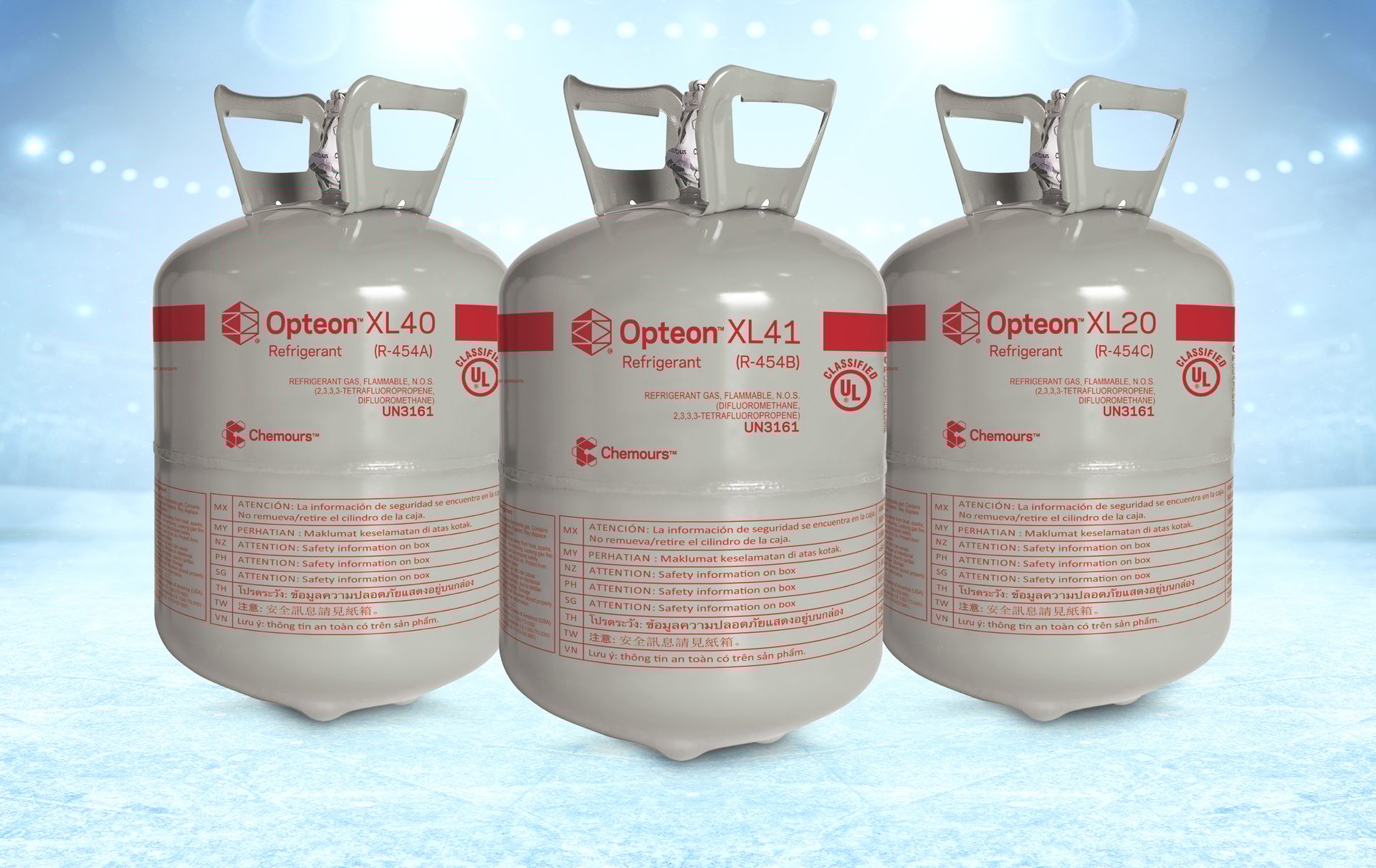
Opteon R-454A, B & C products. Image courtesy of Chemours.
While the HVACR industry has been gearing up for the A2L transition for several years, 2024 represents a significant threshold, allowing the industry to cross from “getting ready” to “moving forward” with hydrofluoroolefin (HFO) and HFO-blend refrigerants. Key regulations finalized in 2024 have paved the way for OEMs and refrigerant manufacturers like Chemours to move full speed ahead with strategies to build a supply chain that supports and encourages increased demand for low global warming potential (GWP) refrigerants and equipment in residential and commercial HVAC as well as commercial refrigeration sectors. Consequently, OEMs and wholesalers across the industry — and the contractors that supply and service the equipment — can head into 2025 with an eye to determining the right time to introduce low-GWP solutions to their business strategy.
In engaging with HVAC and commercial refrigeration customers and others invested in helping the industry make a smooth transition to A2L technology, Chemours has uncovered several common and recurring topics of discussion. These are addressed below to help the ACHR News audience increase their understanding of where the industry is in the A2L transition, strategize for their adoption of the technology, and increase their confidence in A2Ls as the right solution for their businesses.
Regulatory influences.
The big regulatory drivers low-GWP refrigerant adoption are the U.S. EPA’s American Innovation and Manufacturing (AIM) Act and Significant New Alternatives Policy (SNAP) program. Coming into 2024, the industry started an additional 30% allocation reduction in carbon dioxide equivalent (CO2EQ) production and consumption, as specified by the AIM Act. Phasedowns will continue, working to achieve a total 85% HFC phasedown — from historic baseline levels — by 2036. In addition, the act’s Technology Transitions Program represents a second tier of requirements that limit HFC use. Often referred to as “sector controls,” Technology Transition rules will start as early as Jan. 1, 2025. These rules call for GWP limits for refrigerants based on specific applications, including refrigeration, air conditioning, heat pumps, and more.
The EPA finalized multiple SNAP rules in 2023 and 2024, further encouraging A2L adoption by identifying acceptable substitutes for HFC and HFC-blend refrigerants. SNAP Rule 25, lists seven refrigerants as acceptable, subject to use conditions -or- acceptable, subject to narrowed use limits for specific industrial sectors including Refrigeration and Air Conditioning. Included in this list are R-1234yf (Chemours Opteon YF) as well as “the big 3” — R-454A, R-454B, and R-454C (Opteon XL40, Opteon XL41, and Opteon XL20). The EPA also finalized SNAP Rule 26, which deems 10 refrigerants as acceptable, subject to use conditions, for various commercial refrigeration applications, including commercial ice machines, industrial process refrigeration, cold-storage warehouses, retail food refrigeration, and ice rinks. R-1234yf, R-454A, and R-454C are all included in SNAP Rule 26.
The key takeaway here is that established regulations both support adoption of low-GWP refrigerants and in nearly all instances will require OEMs to cease making new systems charged with incumbent HFCs. So we can expect to see a massive transformation of the HVACR industry. Moving forward, new installations of low-GWP equipment using HFOs and HFO blends will continue to increase as systems approach end of life in both HVAC and commercial refrigeration applications.
Environmental influences.
Benjamin Franklin once said, “Nothing is certain except death and taxes.” Today, we can add another certainty — society’s prioritization of the environment. From decarbonization to resource conservation to circularity and more, every industry, business, and individual is being called on to take steps to restore the health of the planet and create a sustainable future. This “certainty” goes hand in hand with the transition to low-GWP refrigerants. HFO and HFO-blend refrigerants are the industry’s solution to the high GWP legacy of HFCs. Compared to HFCs, they break down more quickly in the atmosphere, while offering strong stability in HVAC systems. For example, HFO-1234yf — a key component of many HFO blends — has an atmospheric lifetime of 10 days and a AR4 GWP of 4.
As regional, national, and global environmental strategies advance it will also be increasingly important to consider factors that support them when weighing your refrigerant options. Including how well they support circularity and energy efficiency- through reduced energy consumption.
Cost, performance, and other factors that matter to businesses.
In innovating HFO refrigerants, scientists like ours at Chemours zeroed in on creating refrigerants for a variety of applications that strike an optimum balance of all the critical factors for businesses today. In addition to the environmental properties, these factors include:
- Performance. A2Ls are engineered with capacity and efficiency in mind. They also offer similar operating pressures and temperatures to the refrigerants they are designed to replace.
- Commercial availability. Chemours’ global production network can meet the expanding needs of the market around the world.
- Mild flammability, low toxicity, and an advantageous safety profile.
Choosing the right low-GWP refrigerant is as easy as A, B, C.
Focusing on just three new-generation refrigerants helps create a clear path to making refrigerant transitions that comply with the EPA’s Technology Transition program and SNAP rules and support more sustainable operations. While a number of new refrigerants have been developed recently, a large portion of the HVACR industry’s applications and equipment can be covered by focusing on these three refrigerants: R-454A, R-454B, and R-454C.
Opteon XL40 (R-454A) — AR4 GWP = 239
Developed to replace legacy refrigerants such as R-404A, R-454A is an HFO blend offering zero ozone depletion potential (ODP) and a GWP of 239, which is far lower than R-404A’s GWP of 3,920. R-454A is classified as an A2L refrigerant because it is mildly flammable and has low toxicity. It is suitable for low- and medium-temperature commercial refrigeration applications. The AIM Act Technology Transitions set a maximum GWP of 300 for several types of systems with charge limits up to 200 lbs., such as remote condensing units for food retail walk-ins. These systems are ideal for R-454A, given the refrigerant’s improved performance and reduced GWP compared with R-404A.
Opteon XL41 (R-454B) — AR4 GWP = 467
When it comes to HFO blends coming into the market, R-454B is likely the one you’ve heard the most about. Establishing itself as the predominant replacement for R-410A in new HVAC systems, R-454B started being used earlier in 2024. In fact, R-454B will be used in most equipment manufactured after Dec. 31, 2024. Offering a GWP of 467, compared with R-410A’s GWP of 2,088 (a 78% reduction), R-454B has been selected by the majority of U.S.-based air conditioning and heat pump manufacturers.
Opteon XL20 (R-454C) — AR4 GWP = 148
R-454C, with a GWP of 148, offers compliance with AIM Act regulations and is suitable for new systems in applications requiring a GWP of <150. Two examples are small standalone units and larger system architectures with a charge size of >200 lbs. being developed for supermarkets.
HFO and HFO-blend refrigerants are gaining momentum.
Some of the most compelling evidence that the HVACR industry is ready to leverage the advantages of HFO technology comes from installations that are up, running, and performing beautifully. The first successful installation of a cold-storage refrigeration system using Chemours Opteon XL20 recently took place in Arizona, a region with one of the hottest ambient climates in the U.S. In addition, Opteon XL20 was used in an installation for one of the largest supermarkets in Colombia, marking the first time the refrigerant was successfully used in a cold-storage refrigeration system in Latin America. These are just two examples representing milestones for low-GWP refrigerants — in and beyond commercial refrigeration. As we head into the first half of 2025, the industry anticipates that many OEMs will start rolling out new low-GWP HVAC and commercial refrigeration equipment.
In addition, Chemours is experiencing enormous demand for virtual and in-person technician training on the new refrigerants. This is proof positive that the industry is eager to support businesses across the board in the installation and maintenance of new-generation equipment.
The refrigerant outlook for 2025 — and beyond.
At Chemours, we do not consider any solution “future-proof.” To do so would stifle technological evolution and our ability to innovate as the needs of society change and new opportunities arise for the HVACR industry. However, HFO and HFO-blend refrigerants are solidly grounded in their ability to meet the needs of today and for years to come. The industry will continue to innovate, and we can expect OEMs to engineer additional options for specific applications. Because HFO and HFO-blend refrigerants and equipment offer this agility, everyone with a stake in HVAC and commercial refrigeration can invest confidently in low-GWP technology. From providing attractive solutions for everything from building a new cold-storage facility to replacing an inefficient residential AC unit to supporting a business pursuing bolder goals for reducing its energy consumption and environmental footprint, Chemours Opteon refrigerants are ready to deliver.
To learn about Chemours Opteon portfolio, visit opteon.com or see us at booth 2401 at the 2025 AHR Expo.
Kathy Knutson, Ph.D., PCQI, is the Founder of Kathy Knutson Food Safety Consulting LLC. She is also an author and the former Chair of the Education Committee for the National Cannabis Industry Association (NCIA), with expertise in the fields of bacteriology, food science, and education. She speaks, writes, and trains on U.S. Food and Drug Administration Food Safety Modernization Act (FDA FSMA) compliance, and has trained over 500 Preventive Controls Qualified Individuals (PCQIs) throughout her career. Dr. Knutson works with managers to help them write thorough hazard analyses, food safety plans, recall plans, environmental monitoring programs, and allergen programs. Additionally, she travels to manufacturers to conduct swabbing to locate pathogens during recall investigations, as well as for gap assessments of Good Manufacturing Practices (GMPs) for cannabis-infused edibles. In 2020, Dr. Knutson published her book, titled, Food Safety Lessons for Cannabis-Infused Edibles.